


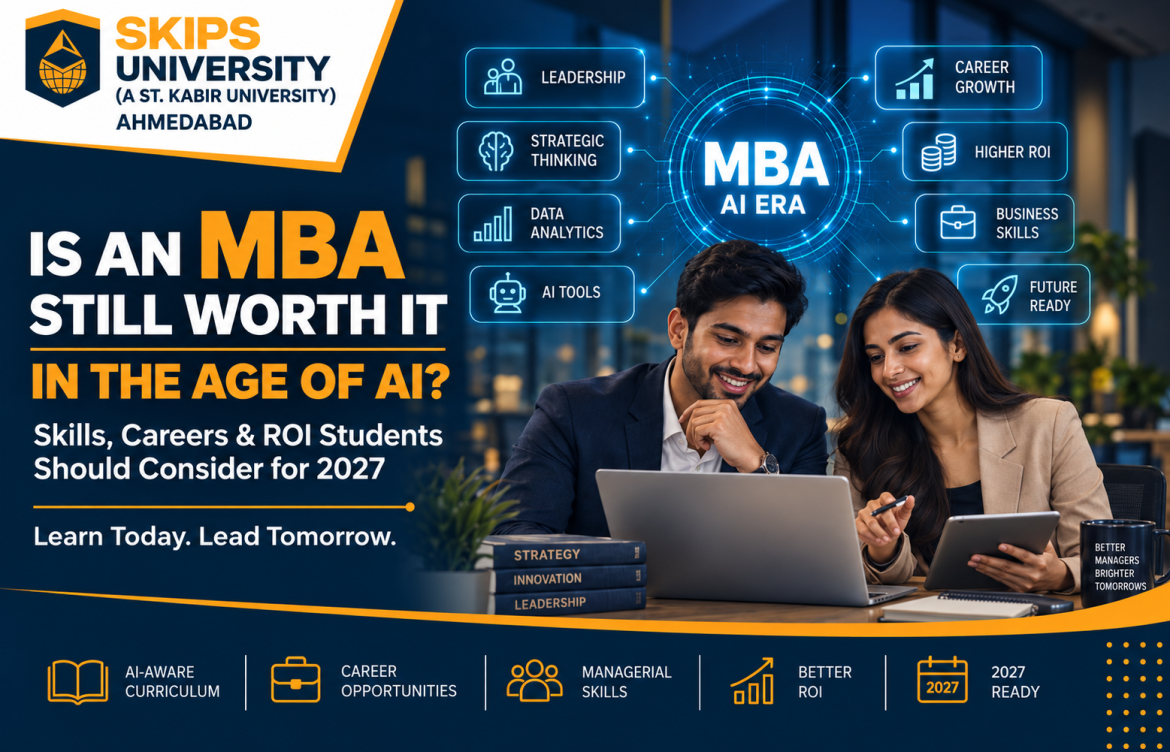
Is an MBA Still Worth It in the Age of AI? Skills, Careers and ROI Students Should Consider for 2027
A few years ago, students choosing an MBA mostly worried about specialisation, placements, fees and college reputation.
Now there is another question sitting right in the middle of that decision:
If AI is already doing research, analysis, presentations, content creation and even parts of decision-making, does an MBA still make sense in 2027?
It is a fair question.
AI has moved very quickly from being a technology topic to becoming part of everyday work. Marketing teams use it to study audiences and create campaign variations. Finance teams use automation and analytics for forecasting. Recruiters use AI tools to screen applicants. Business teams use it to summarise reports, prepare drafts and analyse large amounts of information.
So yes, the workplace is changing.
But that does not automatically mean management education has become less useful.
In many cases, it means students need to be more careful about what kind of MBA they choose and what they actually learn during those two years.
An MBA in 2027 should not be treated as a degree that guarantees a management job. It should be treated as an opportunity to build business judgement, communication, leadership, analytical ability and practical exposure to the technologies changing the workplace.
That is where its value lies.
So, is an MBA worth it in 2027?
For the right student and the right programme, it can be.
The important part is the second half of that sentence.
Doing an MBA only because it is the “next logical degree” after graduation may not be a strong enough reason anymore. The investment is significant, both in money and time. Students should know what they want from the programme.
Some may want to move into management after an engineering or technology degree. Others may want careers in marketing, finance, HR, analytics, consulting or business development. Some working professionals may want to move into roles with greater responsibility.
In those cases, an MBA can provide structure, business exposure and access to opportunities that may otherwise take longer to build.
But a student should still ask a basic question before applying:
What will I be able to do better after completing this MBA?
If the answer is only “I will have another degree”, that is not enough.
AI has changed the value of certain skills
The biggest mistake students can make is assuming that learning a few AI tools is enough to become “future ready”.
Tools change very quickly.
A platform that is popular today may be replaced by something better within a year or two. What lasts longer is the ability to understand a problem, ask the right questions, interpret information and make a sensible decision.
This is especially important in management.
Imagine a marketing manager using AI to generate ten campaign ideas. The real job still involves deciding which audience to target, how much to spend, how to position the brand and whether the campaign is actually helping the business.
The same applies in finance.
Software can analyse data faster than a person, but somebody still has to understand the assumptions behind the numbers and decide whether a recommendation is commercially sensible.
In HR, AI may reduce the time spent on initial resume screening, but hiring decisions still involve judgement, communication and understanding people.
In business analytics, producing a dashboard is becoming easier. Knowing what the dashboard means and what action should follow is much harder.
This is why the conversation around MBA skills is changing.
What employers are likely to value more in 2027
The workplace is clearly becoming more technology-driven, but employers are not looking only for technical skills.
Recent employer research from organisations such as GMAC continues to point towards a mix of capabilities: communication, problem-solving, adaptability, strategic thinking, data skills and an increasing familiarity with AI tools.
That combination makes sense.
Businesses do not need managers who can simply generate information. There is already more information available than most teams know what to do with.
They need people who can make sense of it.
For an MBA student, that means the skill set for 2027 should probably look something like this:
Business understanding.
Communication.
Decision-making.
Data interpretation.
AI literacy.
Financial awareness.
Leadership.
Problem-solving.
Negotiation.
And perhaps most importantly, the ability to keep learning.
These are not glamorous skills. They do not make dramatic social media headlines. But they are the skills that tend to matter when real business problems appear.
Will AI replace MBA jobs?
Some tasks will certainly be automated.
That has already started.
Routine reports, first drafts, basic market research, meeting summaries, repetitive data work and parts of recruitment can now be completed much faster than before.
That does not necessarily mean the entire job disappears.
More often, the job changes.
A junior marketer who spends hours compiling campaign data may now get that report instantly. The value of that person shifts towards understanding why performance changed and what the business should do next.
A finance professional may spend less time preparing spreadsheets and more time interpreting scenarios.
A recruiter may spend less time manually sorting applications and more time evaluating candidates, improving hiring processes and working with business teams.
This is an important distinction for students.
The safer career strategy is not trying to find a role that AI will never touch. There may be very few such roles.
A better strategy is developing the ability to use AI while contributing something beyond what the tool can provide on its own.
The MBA roles that may evolve rather than disappear
Management careers are broad, and no one can predict exactly what every role will look like in five or ten years.
Still, many popular MBA career paths are likely to remain relevant while changing considerably.
Marketing is a good example.
AI is already helping companies with audience research, copywriting, personalisation and performance analysis. Yet marketing still requires positioning, customer understanding, brand thinking and commercial judgement.
Finance is becoming more data-driven, but businesses still need people who understand risk, capital, investment and financial decision-making.
HR is adopting automation, workforce analytics and AI-based recruitment tools, while its most difficult responsibilities still involve people, culture and leadership.
Consulting is another area where AI can speed up research and analysis. The consultant’s value, however, is rarely the ability to collect information alone. It is the ability to understand a complicated problem, structure it properly and help a client decide what to do.
Product management, sales, business development, operations and entrepreneurship are also likely to involve far more AI-assisted work.
For students, the message is fairly simple.
Do not build your career around tasks that can easily be automated. Build it around judgement, business understanding and responsibility.
What MBA students should actually learn about AI
Students do not necessarily need to become programmers.
That depends on the role they want.
A marketing professional may never need to build a machine-learning model. But they should understand what AI can and cannot do, how data is being used and where automation may improve a process.
A finance student should understand how analytics and automation influence forecasting, risk and financial decision-making.
An HR student should know how AI is being used in recruitment and workforce analytics, along with the ethical and practical questions that come with those systems.
A future manager should also know when not to trust an AI output.
That part is often ignored.
AI tools can produce confident answers that are incomplete, incorrect or based on poor assumptions. Managers who use them without checking the underlying logic may simply make bad decisions faster.
AI literacy therefore means more than knowing the latest tool.
It means knowing how to use technology responsibly within a business context.
Is an MBA still a good investment?
This is where the answer becomes personal.
The ROI of an MBA cannot be judged only by looking at one salary figure on a college website.
The real investment includes tuition fees, living expenses, travel, study material and, for some students, income they could have earned during those two years.
The return is also broader than starting salary.
An MBA may help someone enter a different industry, move from a technical function into management, access stronger professional networks or become eligible for roles that would otherwise have been difficult to reach.
Those benefits matter.
But students should still be practical.
Before taking admission, look at what graduates actually do after completing the programme.
Check the kind of companies that recruit.
Look at the roles being offered rather than focusing only on company logos.
Understand the internship structure.
Ask whether students work on live projects.
Look at the curriculum closely.
Speak with current students if possible.
And do not rely only on the highest package.
One exceptional placement does not tell you what the typical student experience looks like.
How students should think about MBA ROI
There is no perfect formula, but a simple way to look at it is:
Total investment versus realistic career improvement.
Suppose one student spends two years in an MBA but does very little beyond classroom work.
Another student uses those same two years to complete internships, work on industry projects, improve communication, learn data tools, understand AI applications, participate in competitions and build relationships with professionals.
They may graduate with the same degree.
Their employability may be very different.
That is why MBA ROI also depends on how the student uses the programme.
A college can provide opportunities, mentors, projects and recruiters.
Students still need to make use of them.
Which MBA specialisation makes sense in the AI era?
There is no single correct answer.
Students often ask whether Business Analytics is now “better” than Marketing, Finance or HR because AI is growing so quickly.
That is too simplistic.
Marketing is becoming more analytical.
Finance is becoming more technology-driven.
HR is increasingly using data.
Operations is becoming more automated.
Even traditional management roles are absorbing technology.
The better question is:
Which area fits your interests and abilities, and does the programme teach it in a modern way?
A student interested in Marketing should look for exposure to consumer behaviour, branding, digital marketing, analytics and sales.
A Finance student may benefit from learning financial analysis, modelling, risk, FinTech and business analytics.
Someone considering HR should look at HR analytics, organisational behaviour, talent management and technology-enabled recruitment.
Business Analytics can be a strong option for students who genuinely enjoy working with data and solving business problems.
The subject should fit the person.
Choosing a specialisation only because it sounds futuristic is rarely a good idea.
What about a dual-specialisation MBA?
Dual specialisation can be useful because business functions do not operate separately in the real world.
Marketing managers deal with budgets.
Finance teams need to understand commercial priorities.
HR professionals work with department heads.
Analytics professionals have to communicate with people who may not have technical backgrounds.
Combining two areas can therefore help students develop a broader view of business.
For example, Marketing and Analytics can work well together.
Finance and Analytics can be valuable for data-oriented financial roles.
HR combined with another management area can provide a wider understanding of organisational decisions.
Still, students should check how much depth each specialisation actually provides.
Two specialisations printed on a degree are not valuable if neither one is taught properly.
Who should seriously consider an MBA in 2027?
An MBA may make sense for someone who wants to move into management, change industries, develop stronger business fundamentals or gain structured exposure to areas such as finance, marketing, HR, analytics and strategy.
It may also make sense for students from technical backgrounds who want to move closer to customers, products, teams or business decisions.
Working professionals may use an MBA to prepare for larger responsibilities.
Entrepreneurs may find management education useful for understanding finance, markets, operations and strategy, though an MBA is certainly not compulsory for starting a business.
The important thing is having a reason.
“Everyone in my batch is doing an MBA” is not a career plan.
When an MBA may not be the best choice
There are situations where waiting could make more sense.
If a student has no idea why they want the degree, gaining some work experience first may provide more clarity.
If the programme is extremely expensive and the likely career outcomes do not justify the investment, that should be considered seriously.
Someone who wants to remain deeply specialised in a technical field may benefit more from advanced technical education.
And students who expect an MBA to compensate for weak communication, lack of practical experience or limited effort are likely to be disappointed.
The degree can open doors.
It cannot walk through them for you.
What should students look for in an MBA programme in 2027?
The brochure is not enough.
Students should look at the actual learning experience.
Does the curriculum reflect what businesses are using today?
Are analytics and technology integrated into management subjects?
Do students work on real business problems?
Is there meaningful internship exposure?
Do faculty members bring academic as well as industry perspectives?
How does the institution help students improve communication and interview skills?
What kind of career support is available?
What roles do recruiters offer?
And how transparent is the institution about outcomes?
AI exposure should be part of that evaluation, but it should not be the only factor.
A management programme still needs strong fundamentals.
Students need to understand customers, money, people, competition and strategy.
Technology becomes useful when those foundations are already in place.
Is Ahmedabad a good place to study management?
Ahmedabad offers students access to a diverse business environment.
The city and the wider Ahmedabad-Gandhinagar region have strong activity across manufacturing, pharmaceuticals, financial services, technology, retail, infrastructure, consulting and entrepreneurship.
GIFT City has added another dimension to the region, particularly around financial and technology-driven businesses.
For students, proximity to such an ecosystem can be useful for internships, industry interactions, guest lectures, projects and networking.
However, location should still be treated as one factor among many.
A student should choose an MBA programme based on the quality of education, industry exposure, affordability and career fit, not simply because the campus is located in a major city.
How SKIPS University approaches MBA learning
At SKIPS University, the MBA programme is designed around management education with dual-specialisation options and practical exposure.
Students can explore areas including Marketing, Finance, Human Resources and International Business while developing broader management capabilities.
The programme also includes a summer internship, giving students an opportunity to experience how classroom concepts work in an actual organisation.
For students who want stronger exposure to technology and analytics, SKIPS University also offers an MBA with a PG Diploma in AI & Business Analytics in collaboration with IBM.
The idea behind such a combination is not to turn every management student into a software engineer.
It is to help future managers understand how data, analytics and AI are changing business decisions.
Students considering the programme should review the latest curriculum, eligibility, fees, internship structure and placement information before applying.
That same advice applies to any MBA programme they are comparing.
The bigger question for 2027
AI has made one thing very clear.
Knowing information is becoming less valuable than knowing what to do with it.
Anyone can now ask a tool to explain a marketing strategy, summarise a financial report or generate a business plan.
The harder part remains deciding whether that information is useful.
Is the recommendation realistic?
What assumptions are being made?
What happens if those assumptions are wrong?
How should the organisation respond?
How will people react?
What is the commercial impact?
Those are questions managers deal with.
And that is probably the strongest argument for why management education still matters.
The MBA of the future cannot simply teach students to remember frameworks.
It has to teach them how to think.
Is an MBA worth it in 2027? The practical answer
For some students, absolutely.
For others, perhaps not yet.
The answer depends on career goals, programme quality, financial investment and what the student is prepared to put into the experience.
AI does not make an MBA irrelevant.
It makes an outdated MBA less useful.
Students entering management education in 2027 should look for a programme that combines strong business fundamentals with practical exposure, data awareness, technology understanding, communication and real industry interaction.
Most importantly, they should stop thinking of AI as something they need to compete against.
The better question is how they can use it intelligently.
Because in the workplace ahead, knowing how to generate an answer may become common.
Knowing whether it is the right answer for the business will still matter.
Frequently Asked Questions
Is an MBA worth doing in 2027?
It can be, particularly for students who want to move into management, change career direction or develop stronger business skills. The value depends on the quality and cost of the programme, the practical exposure available and how closely it matches the student’s career goals.
Will AI reduce MBA job opportunities?
AI is likely to automate some repetitive tasks within management roles, but many jobs will evolve rather than disappear completely. Employers will still need professionals who can interpret information, communicate, manage people and make business decisions.
Which skills should MBA students focus on for 2027?
Students should develop communication, problem-solving, strategic thinking, data interpretation, AI literacy, leadership, financial awareness, negotiation and decision-making skills.
Which MBA specialisation is best for the future?
There is no one best specialisation. Marketing, Finance, HR, International Business and Business Analytics can all lead to relevant career opportunities. The right choice depends on the student’s interests, strengths and career plans.
Is Business Analytics a good MBA specialisation?
It can be particularly useful for students who enjoy working with data and want to apply analytics to business decisions. Students should look beyond the specialisation name and check the actual curriculum, tools, projects and career outcomes.
Is an MBA useful after engineering?
Yes, particularly for engineers who want to move towards product management, consulting, business analytics, operations, sales, entrepreneurship or general management. Those planning a highly technical career should compare an MBA with specialised technical education before deciding.
Does an MBA guarantee a high salary?
No. Salary depends on many factors, including the institution, industry, role, prior experience, individual performance and economic conditions. Students should study realistic placement outcomes instead of relying on the highest advertised package.
How should students calculate MBA ROI?
Students should compare the full cost of the programme with realistic career benefits. Fees, living expenses and lost income should be considered alongside placement opportunities, internships, skill development, career mobility and professional networks.
Is Ahmedabad a good city for MBA students?
Ahmedabad and the wider Ahmedabad-Gandhinagar region have a diverse business ecosystem covering manufacturing, finance, technology, pharmaceuticals, retail and entrepreneurship. This can create useful opportunities for internships and industry exposure, though programme quality should remain the main consideration.
What should I check before choosing an MBA college?
Look at recognition, curriculum, faculty, internships, specialisations, industry exposure, placement information, recruiter profiles, fees, alumni outcomes and the opportunities available to build practical skills.