


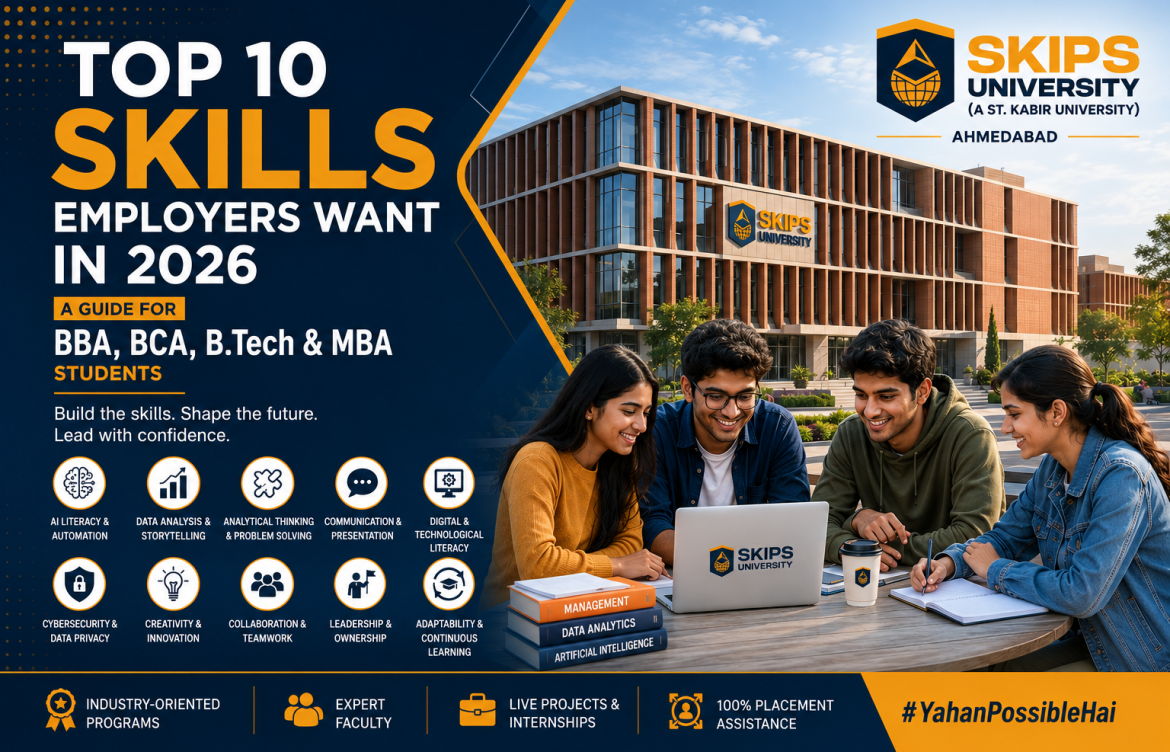
Top 10 Skills Employers Want in 2026: A Guide for BBA, BCA, B.Tech and MBA Students
A degree can help you qualify for a job, but your skills often decide whether you get selected.
Employers in 2026 are looking beyond marks, certificates and academic knowledge. They want graduates who can use technology, solve practical problems, communicate clearly, work with different teams and continue learning as industries change.
This shift is not limited to technology companies. Artificial intelligence, automation and data are now influencing careers in marketing, finance, human resources, software development, operations, consulting and entrepreneurship.
The World Economic Forum estimates that approximately 39% of workers’ existing skills may be transformed or become outdated between 2025 and 2030. It also reports that analytical thinking remains the most sought-after core skill, while AI, big data, cybersecurity and technological literacy are among the fastest-growing skill areas.
LinkedIn’s 2026 analysis of the Indian employment market highlights similar areas. AI and automation, data and analytics, cybersecurity, business growth, communication, collaboration and project management are among the major skill categories gaining importance in India.
For BBA, BCA, B.Tech and MBA students, the message is simple: academic knowledge remains important, but it must be supported by practical abilities that can be demonstrated during an interview.
What Skills Do Employers Want in 2026?
Employers in 2026 primarily want candidates with the following ten skills:
- AI literacy and workflow automation
- Data analysis and data storytelling
- Analytical thinking and problem-solving
- Communication and presentation skills
- Digital and technological literacy
- Cybersecurity, data privacy and responsible technology use
- Creativity and innovation
- Collaboration and stakeholder management
- Leadership, ownership and project execution
- Adaptability, resilience and continuous learning
These skills are relevant across business, management, computer applications, engineering and technology careers. However, the way students apply them will depend on their chosen programme and career path.
1. AI Literacy and Workflow Automation
Knowing how to use artificial intelligence is quickly becoming a basic workplace requirement.
AI literacy does not mean that every student must become an AI engineer. It means understanding what AI can do, where it can be useful, how to write clear instructions and how to check whether its output is accurate.
Employers are interested in candidates who can use AI to improve productivity without blindly depending on it.
For example:
- A BBA student can use AI to study customer feedback and develop campaign ideas.
- A BCA student can use an AI coding assistant while checking the generated code for errors.
- A B.Tech student can use AI for technical research, documentation, testing or prototype development.
- An MBA student can use AI to compare markets, analyse business information and prepare strategic presentations.
LinkedIn’s 2026 India skills report places prompt engineering, workflow automation, AutoML, APIs and large language model operations among the fast-growing AI and automation skills.
How Students Can Build This Skill
Start by using AI for small but meaningful tasks. Ask it to explain a difficult concept, organise research findings or suggest different approaches to a problem. Then verify the answer using reliable sources.
Create at least one project that shows how you used AI to save time, improve accuracy or solve a genuine problem. In an interview, the result of that project will be more valuable than simply saying that you know how to use an AI tool.
2. Data Analysis and Data Storytelling
Most organisations collect large amounts of data. Their challenge is finding people who can turn that data into useful decisions.
Data analysis involves examining information, recognising patterns and drawing logical conclusions. Data storytelling is the ability to explain those findings in a way that managers, clients and team members can understand.
Imagine that a company’s sales decreased last month. An employer does not only need someone who can create a chart. The company needs someone who can answer:
- Which product experienced the largest decline?
- Which customer group changed its behaviour?
- Was the decline connected to price, competition or seasonality?
- What should the company do next?
LinkedIn identifies querying, database optimisation, data analysis, data ethics and data storytelling as fast-growing skills in India because companies increasingly depend on data for pricing, forecasting and business growth.
Useful Tools for Students
Depending on your programme, you can begin with:
- Microsoft Excel or Google Sheets
- Power BI or Tableau
- SQL
- Python
- Google Analytics
- CRM and business intelligence platforms
BBA and MBA students do not need to become full-time programmers to work with data. However, they should be able to read reports, understand business metrics and explain what the numbers mean.
BCA and B.Tech students should go deeper into databases, SQL, programming, dashboards and data structures.
3. Analytical Thinking and Problem-Solving
Employers do not expect fresh graduates to know everything. They do expect them to approach unfamiliar problems logically.
Analytical thinking means breaking a large problem into smaller parts, examining the available information and selecting a practical solution.
According to the World Economic Forum, seven out of ten surveyed companies consider analytical thinking an essential core skill.
Consider a simple workplace situation: customers are abandoning an online application form before completing it.
A weak response would be, “The form is not working well.”
An analytical response would examine:
- The step where most users leave
- The loading speed on mobile devices
- Whether the form asks for unnecessary information
- The source of the website traffic
- Feedback received from users
- Possible changes that can be tested
This structured approach is valuable in almost every career.
How to Demonstrate Problem-Solving
During an interview, avoid giving only theoretical definitions. Explain a real situation using this structure:
Problem → Analysis → Action → Result → Learning
You can use an example from an internship, academic project, coding competition, business case study, student club or volunteer activity.
4. Communication and Presentation Skills
A strong idea has limited value if it cannot be explained clearly.
Employers want graduates who can write professional emails, speak confidently in meetings, listen carefully, create clear presentations and adjust their communication for different audiences.
Communication is not about using difficult English. In fact, unnecessary jargon often makes communication weaker. Good communication is clear, organised and easy to understand.
A software developer may need to explain a technical issue to a non-technical client. A marketing executive may need to present campaign results to senior management. A financial analyst may need to explain why costs increased. A team leader may need to give constructive feedback without creating conflict.
Ways to Improve Communication
Students can build this skill by:
- Giving classroom presentations
- Participating in group discussions
- Writing project summaries
- Practising professional emails
- Explaining technical concepts in simple language
- Recording and reviewing mock interview answers
- Participating in debates, clubs and student events
The objective is not to memorise impressive words. It is to communicate an idea with confidence, accuracy and purpose.
5. Digital and Technological Literacy
Technology is no longer limited to IT departments.
Marketing teams use automation and analytics platforms. Finance professionals use digital dashboards and forecasting tools. HR teams use applicant tracking systems. Operations teams use enterprise software. Managers use collaboration and project-management platforms.
Digital literacy means being comfortable with technology, learning new tools quickly and choosing the right tool for the task.
For BBA and MBA students, this may include spreadsheets, CRM platforms, presentation tools, digital marketing systems and business analytics software.
For BCA and B.Tech students, it may include programming languages, cloud platforms, databases, version control, APIs, software testing and development frameworks.
The World Economic Forum identifies technological literacy as one of the fastest-growing skills for the period leading to 2030.
At SKIPS University, programmes such as BCA and B.Tech combine academic foundations with exposure to programming, cloud computing, analytics, AI and other contemporary technologies.
6. Cybersecurity, Data Privacy and Responsible Technology Use
As businesses become more digital, the responsibility of protecting information is no longer limited to cybersecurity specialists.
Every employee handles some form of sensitive information. It may include customer details, passwords, financial documents, employee records, business strategies or confidential communication.
Students should understand basic digital safety practices such as:
- Creating secure passwords
- Using multi-factor authentication
- Identifying phishing attempts
- Protecting personal and business information
- Avoiding unauthorised software
- Understanding access permissions
- Checking how AI tools store and use uploaded data
For technical students, cybersecurity can also become a specialised career path involving network security, threat detection, incident response, cloud security and secure application development.
LinkedIn’s India analysis identifies cloud infrastructure, threat detection, incident management, IT automation and real-time monitoring among the growing technology skills.
Responsible technology use also includes checking AI-generated information, recognising possible bias and avoiding the careless sharing of confidential data.
7. Creativity and Innovation
Creativity is not limited to graphic design or advertising.
A programmer uses creativity to find a simpler solution. A business student uses it to develop a new customer experience. An engineer uses it to improve a product. A manager uses it to redesign an inefficient process.
Employers value candidates who can look beyond the obvious answer.
The World Economic Forum lists creative thinking among the skills expected to rise in importance as technology, economic pressure and workplace structures continue to change.
How Students Can Develop Creativity
Try solving the same problem in three different ways. Study how other industries handle similar challenges. Ask why an existing process works the way it does and whether it can be improved.
Creativity becomes more useful when it is connected to a real purpose. A creative idea should ideally improve cost, speed, customer experience, accessibility, quality or productivity.
8. Collaboration and Stakeholder Management
Most professional work is completed through teams.
Employees regularly work with colleagues from different departments, backgrounds and levels of seniority. They may also interact with clients, vendors, consultants, investors or government authorities.
Collaboration means more than being polite. It includes sharing information, respecting deadlines, resolving disagreements and supporting a common objective.
Stakeholder management goes a step further. It requires understanding what different people expect from a project and communicating with them accordingly.
For example, a software project may involve developers, designers, testers, clients and managers. Each group has different priorities. A successful professional must understand these priorities and help everyone move towards the same outcome.
LinkedIn’s 2026 India skills report highlights collaboration, team management, stakeholder management, budget management and project management under the growing people and leadership skill category.
9. Leadership, Ownership and Project Execution
You do not need a managerial title to demonstrate leadership.
For a fresher, leadership can mean taking responsibility, organising work, helping a teammate, solving a small issue without being repeatedly reminded or completing a task properly.
Employers notice candidates who take ownership.
Suppose you are assigned a group project. Ownership means that you do not disappear after completing your individual part. You check whether the overall project is moving forward, identify possible delays and support the final delivery.
Project execution is equally important. Many students have ideas, but employers value candidates who can convert an idea into a completed result.
A Simple Project Execution Framework
- Define the outcome.
- Divide the work into smaller tasks.
- Assign responsibilities.
- Set realistic deadlines.
- Track progress.
- Communicate problems early.
- Review the final quality.
- Record what you learned.
Leadership, social influence and talent management are among the skills expected to grow in importance as organisations manage technological and workforce transformation.
10. Adaptability, Resilience and Continuous Learning
The tools you use in your first job may change within a few years. Some tasks may become automated, while completely new responsibilities may emerge.
Adaptability is the ability to learn, adjust and remain effective when circumstances change.
Resilience means responding constructively when a project fails, an interview does not go well or a plan needs to be changed.
Continuous learning is what keeps both abilities active.
Employers are not only asking, “What does this student know today?” They are also asking, “Can this person learn what the organisation will need tomorrow?”
The World Economic Forum identifies resilience, flexibility, agility, curiosity and lifelong learning among the skills expected to remain important through 2030.
Students can demonstrate adaptability by discussing a situation where they received feedback, changed their approach and produced a better result.
Skills Roadmap for BBA, BCA, B.Tech and MBA Students
Although the ten skills are useful for everyone, students should combine them with abilities connected to their chosen field.
| Programme | Priority Skills to Build | Examples of Practical Evidence |
|---|---|---|
| BBA | Business communication, Excel, analytics, digital marketing, customer understanding, negotiation and AI literacy | Market research report, sales dashboard, campaign plan, business presentation or internship project |
| BCA | Programming, databases, APIs, cloud fundamentals, cybersecurity, version control and problem-solving | GitHub portfolio, working application, database project, API integration or coding competition |
| B.Tech | Technical foundations, system design, programming, testing, cloud computing, teamwork and documentation | Prototype, engineering project, technical paper, open-source contribution or internship work |
| MBA | Strategy, finance, marketing, operations, analytics, leadership, stakeholder management and AI-assisted decision-making | Business case analysis, consulting project, financial model, research study or live industry project |
The BBA curriculum at SKIPS University includes areas such as leadership, decision-making, communication, teamwork, problem-solving, project management, strategic planning and business analytics.
SKIPS University’s BCA and B.Tech programmes focus on practical technology learning, while its MBA programme combines management foundations, specialisations, internships and industry exposure.
A Practical 90-Day Skill-Building Plan
Trying to learn everything at once usually leads to unfinished courses and very little practical progress. A focused 90-day plan can produce better results.
Days 1–30: Build the Foundation
Select one technical skill and one human skill.
For example:
- Excel and presentation skills
- Python and problem-solving
- Power BI and communication
- Digital marketing and data analysis
- AI literacy and professional writing
Learn the basic concepts and practise for a fixed amount of time every week.
Days 31–60: Create a Real Project
Use your skills to build something that can be shown to an employer.
Possible projects include:
- A customer behaviour dashboard
- A small mobile or web application
- A competitor analysis
- A financial forecasting model
- A digital marketing campaign plan
- A cybersecurity awareness guide
- A business process automation workflow
Choose a problem that is specific enough to complete but meaningful enough to discuss during an interview.
Days 61–90: Present and Improve Your Work
Prepare a short explanation covering:
- What problem you selected
- Why the problem mattered
- What tools you used
- What difficulties you faced
- What result you achieved
- What you would improve next
Add the project to your resume, LinkedIn profile or portfolio. Practise explaining it in under two minutes.
Common Mistakes Students Should Avoid
Collecting Certificates Without Building Projects
A certificate can show that you completed a course. A project shows that you can apply what you learned.
Depending Completely on AI-Generated Work
AI can assist your learning, but submitting work you do not understand will become a problem during interviews and practical evaluations.
Learning Too Many Tools at Once
Employers usually prefer meaningful proficiency in a few relevant tools over superficial knowledge of twenty different platforms.
Ignoring Communication Skills
Strong technical knowledge may help you clear an assessment, but communication often determines how effectively you perform in interviews, meetings and team projects.
Waiting Until the Final Semester
Employability cannot be built a few weeks before placement season. Students should begin developing projects, communication skills and industry exposure from the early stages of their programme.
Frequently Asked Questions
What is the most important skill employers want in 2026?
Analytical thinking remains one of the most important core skills, while AI literacy and data skills are among the fastest-growing areas. The strongest candidates combine analytical thinking with practical technology knowledge and clear communication.
What skills should BBA students learn in 2026?
BBA students should focus on business communication, Excel, data analysis, digital marketing, customer understanding, negotiation, presentation skills, AI literacy and project management.
What skills should BCA students learn for a good job?
BCA students should build strong foundations in programming, databases, SQL, APIs, cloud computing, cybersecurity, Git, software testing and problem-solving. They should also maintain a portfolio of working projects.
Which skills are important for B.Tech students?
B.Tech students need technical knowledge, programming, system thinking, product development, testing, data skills, documentation, teamwork, communication and an understanding of AI-assisted engineering tools.
Which skills should MBA students develop?
MBA students should develop strategic thinking, business analytics, financial understanding, marketing knowledge, leadership, stakeholder management, negotiation, communication and AI-assisted decision-making.
Are soft skills still important when companies are using AI?
Yes. AI can automate certain tasks, but employers continue to value analytical thinking, creativity, resilience, leadership and collaboration. Human judgement is especially important when decisions involve customers, teams, ethics or uncertain situations.
Can certificates help students get jobs?
Certificates can strengthen a profile when they are relevant and supported by practical work. However, certificates alone cannot replace projects, internships, problem-solving ability and interview performance.
How can a fresher prove their skills without work experience?
Freshers can use academic projects, internships, competitions, freelance assignments, student clubs, volunteer work, case studies and self-initiated projects as evidence of their abilities.
Is coding necessary for every student?
No. Coding is essential for many software and technology careers, but not for every business role. However, students from all programmes should develop basic digital literacy and understand how technology and data affect their chosen field.
How many skills should a student learn at one time?
Students should begin with two or three complementary skills. For example, data analysis, communication and a domain-specific skill can form a strong combination. Depth and practical application are more valuable than an excessively long list.
Final Thoughts
The workplace of 2026 does not reward academic knowledge alone. It rewards students who can apply knowledge, use technology responsibly, understand data, communicate with confidence and learn continuously.
BBA, BCA, B.Tech and MBA students do not need to master all ten skills immediately. The better approach is to begin with the skills most relevant to their career goal, practise them consistently and build real evidence through projects and industry exposure.
Your degree tells an employer what you studied.
Your skills show what you can contribute.
At SKIPS University, students are encouraged to move beyond classroom learning through practical assignments, presentations, technology exposure, projects, internships and industry-oriented learning. By combining a strong academic foundation with relevant workplace skills, students can prepare not only for their first job but also for long-term career growth.