


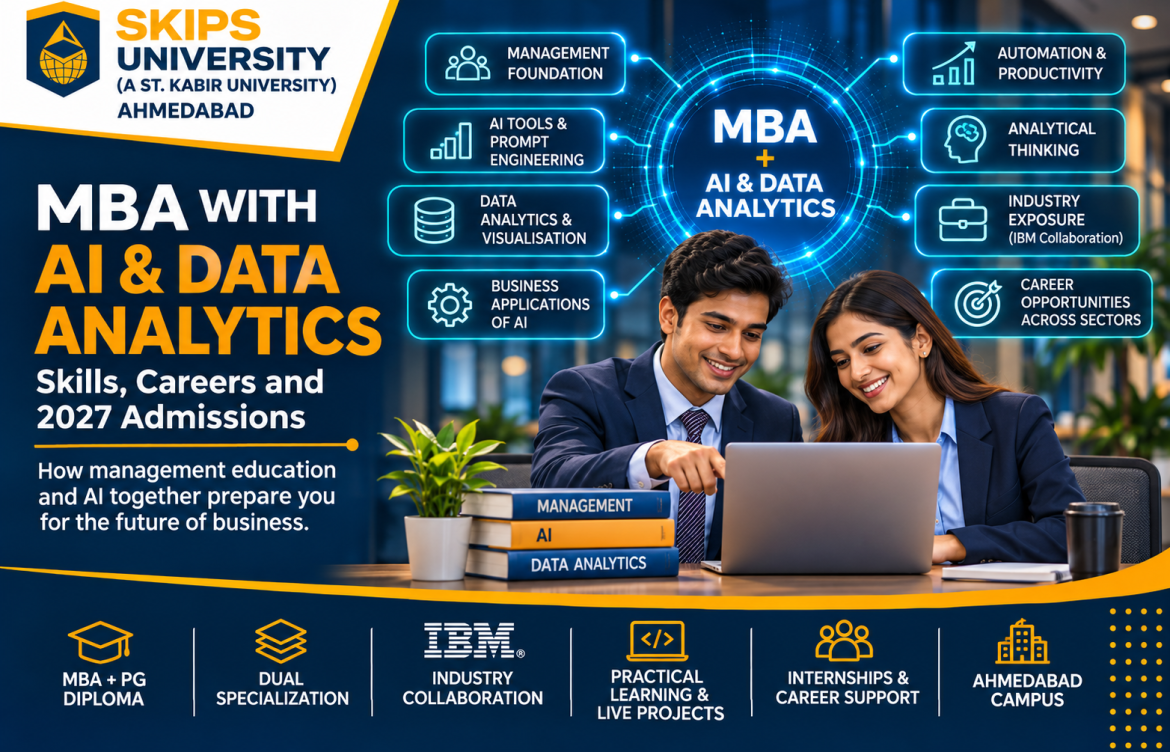
MBA with AI & Data Analytics: Skills, Careers and 2027 Admissions
An MBA teaches you how to understand business. AI can help you understand data, solve problems and make decisions more efficiently. But what happens when you learn both together?
For students planning an MBA in 2027, this is becoming an important question.
Think about a typical business decision. A marketing manager needs to understand why sales have declined. A finance manager must evaluate costs and future revenue. An HR manager wants to improve recruitment efficiency. An operations manager needs to reduce delays without increasing expenses.
Traditionally, management professionals have relied on reports, experience, teamwork and analytical skills to solve these problems. Today, artificial intelligence and data analytics can support those decisions.
This is why combining management education with practical AI knowledge deserves serious consideration.
At SKIPS University, Ahmedabad, the MBA + PG Diploma in AI & Business Analytics offering brings together management learning and technology-focused skills, with the aim of helping students prepare for modern business roles.
What Is an MBA with AI and Data Analytics?
An MBA with AI and Data Analytics combines management education with the practical use of artificial intelligence, business data and analytical tools. Students develop an understanding of traditional business functions while learning how technology can support decision-making, productivity and problem-solving.
The goal is not necessarily to turn every management student into a software developer or AI engineer.
Instead, it is to help future business professionals understand three important questions:
- What is the business problem we are trying to solve?
- What information or data do we need to make a better decision?
- How can AI and analytics help us reach a reliable conclusion?
These questions matter whether a student eventually works in marketing, finance, human resources, operations, consulting or entrepreneurship.
For students exploring management education in Gujarat, the MBA programme at SKIPS University provides a starting point for understanding the management side of this learning journey.
Is an MBA Without AI Really Worthless?
You may have seen the question: “MBA without AI = Worthless?”
It is an attention-grabbing way to start a conversation, but the reality deserves a more thoughtful answer.
An MBA without a dedicated AI component is not automatically worthless. Strong management fundamentals, communication, leadership, financial understanding and business judgement remain valuable.
However, students who graduate without understanding how AI and data are changing business may find themselves less prepared for certain technology-enabled roles.
Consider two candidates applying for a marketing position.
Both understand market research, consumer behaviour and marketing strategy. One can also interpret campaign dashboards, use AI responsibly for research, compare audience segments and explain how data supports a marketing decision.
The second candidate has an additional set of practical skills to demonstrate.
That is the real opportunity: not replacing management education with AI, but making management knowledge more useful through AI.
Why AI and Data Analytics Matter for MBA Students in 2027
The workplace is changing, and employers are increasingly looking for people who can combine technical awareness with human judgement.
According to the World Economic Forum’s Future of Jobs Report 2025, employers expect approximately 39% of workers’ existing skill sets to change or become outdated between 2025 and 2030.
The report also identifies AI and big data among the fastest-growing skills, while analytical thinking remains a major priority for employers.
This does not mean every job will become an AI job.
It means professionals across different functions will increasingly need to understand the tools and information available to them.
AI is changing everyday business work
A few examples explain the shift.
Marketing: Teams can examine customer behaviour, analyse campaign results, identify patterns and develop better-informed marketing strategies.
Finance: Professionals can use data analysis to study expenses, compare financial scenarios, support forecasting and identify unusual transactions.
Human resources: HR teams can improve reporting, organise recruitment information and analyse workforce trends, while maintaining fairness, privacy and human oversight.
Operations: Businesses can study demand patterns, inventory movement and process bottlenecks to improve planning.
Management: Leaders can use dashboards and analytical tools to compare options before making important decisions.
AI can assist in each area. But it cannot remove the need for professional accountability, contextual understanding or sound judgement.
Students who understand both sides may be better prepared to contribute to modern organisations.
What Will You Learn When Management Meets AI?
A meaningful MBA and AI learning experience should connect business concepts with practical applications rather than treating them as unrelated subjects.
1. Strong management fundamentals
Business education builds the foundation for understanding how organisations operate.
Important areas include:
- Management concepts and business strategy
- Marketing and consumer behaviour
- Financial analysis and budgeting
- Human resource management
- Operations and business processes
- Leadership, teamwork and communication
These subjects help students understand why businesses make decisions and how those decisions affect customers, employees and financial performance.
2. AI tools and prompt engineering
AI literacy involves more than entering a question into a chatbot.
Students should learn how to provide clear instructions, evaluate responses, check information and understand when AI-generated answers may be unreliable.
For example, a management student might use an AI tool to organise customer feedback into themes.
The real skill lies in verifying the themes, identifying what they mean for the business and deciding which action is appropriate.
Students interested in this area can also explore our article on AI skills for students and working professionals.
3. Data analytics and visualisation
Businesses collect information through sales systems, marketing platforms, financial reports, customer interactions and operational processes.
Data analytics helps turn this information into something useful.
Students can develop skills in interpreting trends, comparing performance indicators, understanding dashboards and presenting conclusions clearly.
A well-designed dashboard may show that sales are declining. A capable manager must investigate why.
4. Business applications of AI
Learning becomes more meaningful when students can connect technology to real business problems.
Possible applications include analysing customer feedback, identifying product demand trends, comparing marketing performance and preparing management reports.
The objective should be to understand both the business opportunity and the limitations of the technology being used.
5. Automation and productivity
Many organisations still spend considerable time preparing repetitive reports, consolidating information and completing administrative tasks.
AI-enabled workflows and automation tools can make certain processes more efficient.
Students who understand these tools can explore how to reduce manual effort while maintaining accuracy, privacy and appropriate approval processes.
6. Advanced analytical thinking
An analytical mindset involves questioning assumptions, interpreting evidence and evaluating different explanations.
AI can help process information quickly, but students must still learn to identify weak data, misleading conclusions and unrealistic recommendations.
This combination of technology awareness and critical thinking is particularly important for future managers.
MBA + PG Diploma in AI & Business Analytics at SKIPS University
Students interested in combining management and technology education can explore the MBA + PG Diploma in AI & Business Analytics offering at SKIPS University.
The programme is presented as an opportunity to connect management education with AI and analytics-oriented learning.
SKIPS University’s standard MBA is a two-year, full-time programme that includes management subjects, electives, industry exposure and an eight-week summer internship.
The university also offers MBA dual-specialisation options, allowing students to build knowledge across management disciplines such as Marketing, Finance, Human Resources and International Business, subject to the available specialisation combinations.
The combined MBA and PG Diploma pathway is designed to introduce additional technology-oriented learning.
Importantly, an MBA is a postgraduate degree, while a PG Diploma is a separate academic qualification. Applicants should confirm the exact qualification titles, awarding arrangements, curriculum and assessment requirements with the university before enrolling.
Students can explore the MBA + PG Diploma programme and admission information on the official website.
Industry collaboration with IBM
SKIPS University’s official programme information describes its MBA + PG Diploma in AI & Business Analytics offering as being developed in collaboration with IBM.
Industry-oriented collaboration can help connect academic concepts with practical technologies and business applications.
The university highlights advanced tools, live projects, expert guidance and industry exposure as elements of the offering.
Prospective students should review the latest programme brochure to understand the specific role of IBM, the learning resources included and whether any additional certification is available.
An industry collaboration should be evaluated for the actual learning opportunities it provides, rather than being treated as a guarantee of employment.
What Does AI-Enabled Business Learning Look Like in Practice?
Imagine an Ahmedabad-based manufacturing business that sells products across Gujarat and other Indian states.
The company has sales records, customer enquiries, inventory information and monthly expenditure reports. However, its managers struggle to identify which products are likely to experience higher demand.
A useful student project might involve:
- Organising historical sales information.
- Identifying seasonal demand patterns.
- Building a dashboard to compare product performance.
- Exploring analytical methods that could support demand forecasting.
- Recommending inventory and marketing decisions.
- Explaining the limitations of the analysis.
This is an illustrative project example, not a claim about a specific completed university project.
Notice that the work requires more than technical knowledge.
Students must understand inventory costs, customer demand, business risk and how to communicate a recommendation.
This is where management learning and analytical skills complement each other.
Career Opportunities After an MBA with AI and Data Analytics
Students with combined business and analytical capabilities can explore roles across several sectors.
The exact opportunities depend on their specialisation, practical skills, internships, experience and employer requirements.
Business Analyst
Business analysts study processes, requirements and data to help organisations understand problems and identify improvements.
Marketing Analyst
Marketing analysts examine customer behaviour, campaign performance and market information to support marketing decisions.
Business Intelligence Analyst
These professionals create reports and dashboards, interpret performance indicators and communicate business insights.
Operations Analyst
Operations analysts study workflows, resources and performance data to identify opportunities for greater efficiency.
Financial Analyst
Financial analysts examine business performance, budgets, forecasts and investment-related information. Knowledge of analytics may support their work.
Management Trainee
Management trainee positions can provide exposure to different business functions and help graduates develop practical management experience.
AI Business Transformation Roles
Some organisations require professionals who can identify potential AI applications, coordinate implementation efforts and evaluate business outcomes.
These positions may require additional technical expertise or professional experience.
An MBA with AI knowledge does not automatically qualify someone for an AI engineering or machine learning development role. Those careers typically require deeper programming, mathematics and technical training.
Students should compare job descriptions with the skills and projects included in their chosen programme.
How SKIPS University Supports Career Preparation
A successful management education involves more than completing a syllabus.
Students also need opportunities to apply their learning, communicate confidently and prepare for professional responsibilities.
SKIPS University highlights several aspects of its approach:
Industry exposure: Internships, live projects and interactions with professionals can help students understand how businesses operate.
Practical learning: Connecting classroom concepts with business situations can make theoretical knowledge more useful.
Career preparation: The university describes support in areas such as résumé development, interviews, career guidance and placement assistance.
Management and technology learning: Combining business subjects with analytical capabilities can help students develop a broader professional perspective.
SKIPS also showcases a network of companies across banking, technology, manufacturing, consumer goods and other sectors.
Students can explore the university’s recruiter information to learn more.
Recruiter relationships and placement assistance are useful considerations, but they should not be confused with guaranteed job offers. Applicants should request recent, programme-specific placement information when evaluating any university.
Why Consider Ahmedabad for an MBA?
Ahmedabad and the wider Gandhinagar region have a diverse business environment that includes manufacturing, pharmaceuticals, financial services, technology, retail and entrepreneurship.
For management students, this environment provides relevant industries to study and potential opportunities to explore internships, projects and professional networks.
It can also help students understand how businesses of different sizes approach challenges involving customers, supply chains, finance and technology.
SKIPS University has a city campus near SAL Hospital, off Drive-in Road in Thaltej, Ahmedabad, and a university campus in Sanavad, Kalol, Gandhinagar.
Students considering the programme should confirm where their classes, practical sessions and other academic activities will take place.
Location is worth considering, but the more important factors remain programme quality, academic fit, affordability, practical exposure and career support.
Who Should Consider an MBA with AI and Data Analytics?
A programme combining management and technology-oriented learning may be relevant to graduates from several academic backgrounds.
BBA graduates may want to build advanced management knowledge while developing analytical skills.
B.Com graduates may be interested in management, finance, marketing or business analysis roles that increasingly involve digital tools.
B.Tech graduates may want to combine technical understanding with business strategy, product management, operations or leadership skills.
BCA and IT graduates may be interested in moving towards business-facing technology, analytics or management positions.
Working professionals may consider management education when seeking greater responsibility, a career transition or broader business knowledge.
However, the right choice depends on your goals.
A student interested primarily in developing machine learning algorithms may benefit more from specialised technical education. Someone interested in managing teams, solving business problems or using technology to improve organisational performance may find a management-oriented pathway more appropriate.
For a broader perspective, read Is an MBA Still Worth It in the Age of AI?.
What Should You Check Before Choosing an MBA with AI?
A programme title can sound impressive, but students should examine what they will actually study.
Before applying, consider these questions:
- Curriculum: Which AI and data analytics subjects are taught, and how are they assessed?
- Practical exposure: Are there meaningful projects, assignments, internships and opportunities to work with data?
- Faculty: Who teaches management and technology subjects?
- Industry collaboration: What does the partnership include in practical terms?
- Qualifications: Which academic awards will be issued, and by whom?
- Career support: What placement assistance is available, and what do recent programme-specific outcomes show?
- Total cost: What are the tuition fees, additional charges, living expenses and scholarship options?
- Career relevance: Does the programme help develop skills that match the jobs you want?
No course can guarantee that a graduate will remain prepared for every future technological change.
The most valuable education develops the confidence to keep learning and adapt as industries evolve.
MBA Admissions 2027: How to Explore the Programme at SKIPS University
Students considering the 2027 intake can begin by reviewing the official MBA curriculum and the combined MBA + PG Diploma programme details.
The usual process involves checking eligibility, reviewing applicable entrance examination requirements, submitting an application and completing the university’s selection process.
Since eligibility rules, academic dates, entrance requirements, fees and availability can change between admission cycles, applicants should use the latest official information for their intended intake.
The university’s existing MBA information outlines graduate eligibility and accepted management entrance examinations, including CAT, CMAT, XAT, MAT, ATMA and GMAT. Applicants should confirm the requirements applicable to the 2027 admission cycle.
Explore the programme: MBA + PG Diploma in AI & Business Analytics – SKIPS University
Admission enquiries: +91 95121 30000
Location: Ahmedabad–Gandhinagar, Gujarat
Frequently Asked Questions
1. What is an MBA with AI and Data Analytics?
An MBA with AI and Data Analytics combines management education with skills related to artificial intelligence, data interpretation, analytics and technology-supported business decision-making. The exact subjects and qualifications depend on the university’s programme structure.
2. Is an MBA with AI better than a traditional MBA?
Neither option is automatically better for everyone. A traditional MBA may suit many management career goals, while additional AI and analytics learning may be useful for students interested in technology-enabled business roles. Curriculum, practical training, costs and career outcomes matter more than the programme title alone.
3. Can a B.Com or BBA student pursue an MBA with AI?
Yes, graduates from commerce and management backgrounds can pursue such programmes if they meet the institution’s admission requirements. Prior programming experience may not be necessary for all management-oriented AI programmes, but applicants should check the actual curriculum.
4. Do students need coding knowledge to study AI in an MBA?
Not always. Business-oriented AI courses may focus on applications, analytics, prompt engineering, reporting and decision-making. More technical modules may require programming, statistics or other quantitative skills. Students should review prerequisites before enrolling.
5. What is the difference between an MBA and a PG Diploma in AI?
An MBA is a postgraduate management degree. A PG Diploma in AI or Business Analytics is a separate qualification focused on a defined academic area. When offered together, students should confirm each qualification’s curriculum, assessment, duration and awarding arrangements.
6. Does SKIPS University offer an MBA with AI and Business Analytics?
SKIPS University advertises an MBA + PG Diploma in AI & Business Analytics pathway and describes collaboration with IBM on its official programme page. Applicants can obtain the latest details through the university’s admissions team.
7. What jobs can students pursue after an MBA with AI and Analytics?
Depending on skills and experience, graduates may explore business analysis, marketing analytics, business intelligence, operations, finance, consulting-related or management trainee positions. Hiring depends on employer requirements and individual performance.
8. Is placement guaranteed after an MBA with AI?
No. Placement assistance, internships and recruiter relationships can support students, but no programme should be assumed to guarantee a job or salary. Students should examine recent placement information and the support available.
9. Is Ahmedabad a good place to study an MBA with AI?
Ahmedabad and Gandhinagar offer access to a varied business environment. Students can assess opportunities for industry interaction alongside academic quality, fees, campus facilities, curriculum and career support when selecting a programme.
10. How can I apply for the SKIPS University MBA in 2027?
Visit the official SKIPS University MBA admissions page and contact the admissions team to confirm the latest intake dates, eligibility, fees, selection process and available programme combinations.
Final Thoughts: The Future Needs Business Knowledge and Technology Awareness
An MBA can teach students to understand organisations, manage people, evaluate opportunities and make business decisions.
AI and data analytics can help them work with information, recognise patterns and investigate problems more efficiently.
Both have value. Together, they can create a wider range of opportunities for students who are willing to learn and apply their knowledge responsibly.
The important question is not simply whether an MBA includes AI.
It is whether the programme helps students become capable professionals who can think independently, work with modern tools and solve meaningful business problems.
For students planning their management education in 2027, that is a question worth asking before choosing a university.
Explore Your Future with SKIPS University
Discover how management education and AI-oriented learning can complement your career ambitions.
Explore MBA + PG Diploma in AI & Business Analytics at SKIPS University
Call: +91 95121 30000
Website: www.skipsuniversity.edu.in
Research reference: World Economic Forum, The Future of Jobs Report 2025. Programme information is based on SKIPS University’s published MBA and admissions pages. Applicants should confirm current programme details with the university before making an enrolment decision.