


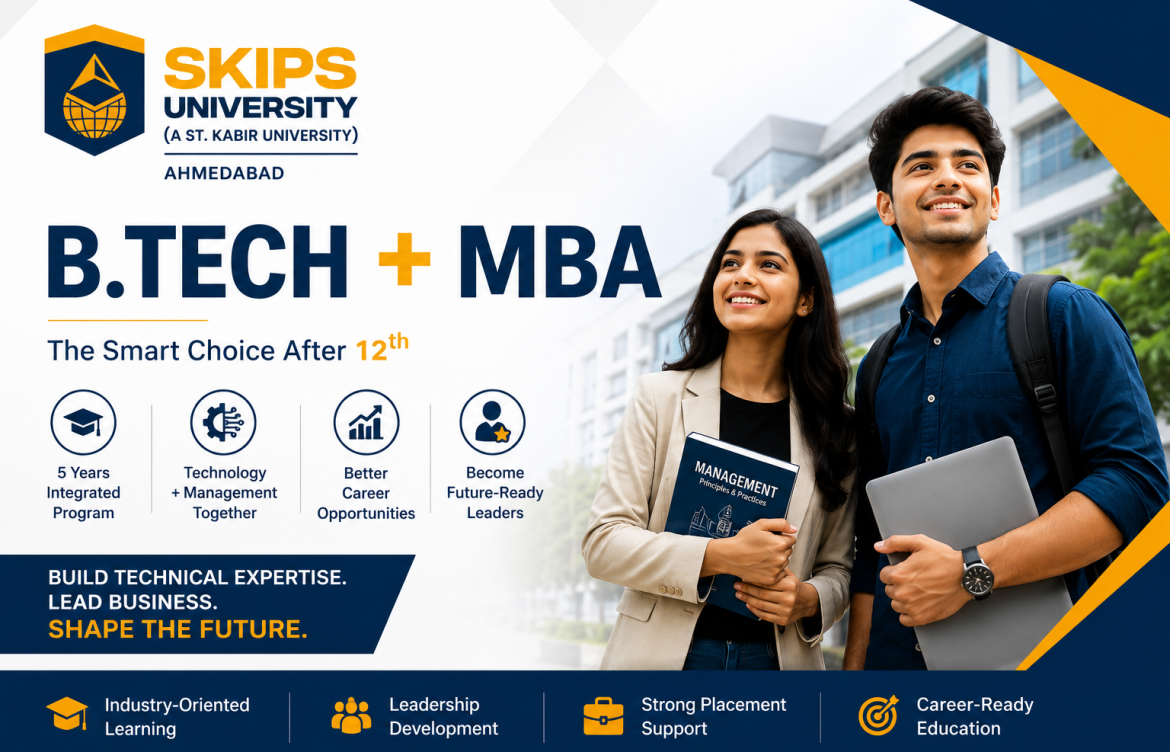
Why an Integrated B.Tech + MBA Is a Smart Career Choice After 12th
Choosing a course after Class 12 is not easy.
A student may enjoy coding and technology but also dream of managing a team, building a startup or leading a company one day. In the traditional education system, such a student normally completes a four-year B.Tech and then spends another two years pursuing an MBA.
That means around six years of education, two separate admission processes and, in many cases, preparation for another entrance examination.
An integrated B.Tech + MBA programme offers a more direct path. It brings engineering and management education together in one structured programme.
Students learn how technology works, but they also understand how companies use that technology to solve problems, serve customers, control costs and grow.
At SKIPS University, the integrated programme combines technical education with business and management learning. The aim is to prepare students for careers where technology and business work together.
| Quick Answer An integrated B.Tech + MBA is generally a five-year programme that combines engineering, technology and business education. It can save one academic year compared with completing a four-year B.Tech and a separate two-year MBA. It is most suitable for students who already want to build careers in technology management, consulting, product development, analytics, FinTech or entrepreneurship. |
What Is an Integrated B.Tech + MBA Programme?
An integrated B.Tech + MBA is a combined undergraduate and postgraduate course. Students follow one planned academic route that begins with technical learning and gradually adds business, leadership and management subjects.
During the technical part, students may study:
- Programming
- Data structures
- Computer networks
- Databases
- Software development
- Artificial intelligence
- Machine learning
- Data science
- Cybersecurity
- Cloud computing
The management part may introduce students to:
- Business strategy
- Finance
- Marketing
- Operations
- Leadership
- Communication
- Entrepreneurship
- Business analytics
- Decision-making
- Project management
The exact subjects and order depend on the university. The main idea is simple: students do not study engineering and management as two completely separate courses. They learn to connect technical decisions with real business needs.
Traditional B.Tech and MBA vs Integrated B.Tech + MBA
| Point | Separate B.Tech and MBA | Integrated B.Tech + MBA |
| Usual duration | Around six years | Around five years |
| Admissions | Two separate processes | One main admission process |
| MBA entrance preparation | Usually required | Normally not required separately |
| Learning approach | Engineering first, management later | Technical and business learning in one pathway |
| Academic continuity | May include a gap or change of institution | More continuous |
| Career planning | Management direction may be chosen later | Leadership and business exposure begins earlier |
| Total cost | Usually higher because of the extra year | May reduce one year of education and living costs |
The integrated programme is not automatically better for every student. It is more suitable for students who already have a clear interest in both technology and management.
Why Are Students Considering Integrated Courses in 2026?
Technology is no longer limited to IT companies.
Banks use AI to study risk. Hospitals use digital systems to manage patient information. Retail companies use data to understand customers. Factories use automation to improve production. Marketing teams use analytics to measure campaigns.
Because of this change, many job roles now require more than one type of knowledge.
A software professional may need to explain a product to a client. A project manager may need to understand how the software is built. A business analyst may have to work with both customers and technical teams.
An integrated B.Tech + MBA programme can help students build these connected skills from the beginning.
Major Benefits of an Integrated B.Tech + MBA
1. Save One Academic Year
The traditional route generally includes four years of B.Tech and two years of MBA. An integrated programme is usually completed in five years.
Saving one year may allow students to:
- Enter the job market earlier
- Start earning sooner
- Gain professional experience at a younger age
- Reduce one year of tuition and living expenses
- Begin building a career without a long study gap
Students should still compare the complete five-year fee with the total cost of pursuing both degrees separately.
2. Avoid a Second Admission Process
Engineering students who decide to pursue an MBA later may need to prepare for entrance examinations and apply to business schools separately.
This can involve entrance-test preparation, application forms, group discussions, personal interviews, college selection and another relocation.
An integrated programme creates a more continuous journey. Students should still ask whether the university has any minimum academic requirement for moving from the B.Tech stage to the MBA stage.
3. Understand Technology and Business Together
Technical knowledge tells students how to build a solution. Management knowledge helps them understand why the solution is needed, who will use it, how much it may cost, how it can generate revenue and how a team will deliver it.
For example, coding knowledge may help a student build a mobile payment application. Business knowledge can help the same student understand customer needs, pricing, competition, cybersecurity risks and market opportunities.
That combination is useful in modern organisations.
4. Develop Leadership Skills Earlier
Leadership is not developed through one subject or one workshop. Students need repeated opportunities to work in teams, present ideas, handle disagreements, manage deadlines, plan projects and learn from feedback.
When management learning is included in the same academic journey, students can start developing these skills earlier instead of waiting until after engineering.
5. Explore More Career Options
A regular B.Tech graduate may begin with a mainly technical role. A student with engineering and management knowledge may also explore roles that connect business teams with technology teams.
- Business Analyst
- Technology Consultant
- Product Management Associate
- IT Project Coordinator
- Data Analyst
- Digital Transformation Associate
- FinTech Analyst
- Corporate Finance Analyst
- Management Trainee
- Startup Founder
A degree does not guarantee a particular job. The role a student receives will depend on skills, internships, academic performance, communication and recruitment conditions.
6. Build a Strong Base for Entrepreneurship
A startup founder often needs to understand more than the product. The founder may also need to manage customer research, product development, finance, sales, marketing, technology, operations, investors and business growth.
Students who learn engineering and management together may find it easier to understand both sides of a technology-based startup.
What Will Students Learn in the Technical Part?
The technical part of the programme may include learning in areas such as:
- C programming
- Data structures
- Java and C++
- Python for Data Science
- Database Management Systems
- Computer networks
- Software engineering
- Artificial intelligence
- Machine learning
- Big Data Analytics
- Deep learning
- Predictive modelling
- Natural Language Processing
- Computer vision
- Generative AI and prompt engineering
- Mobile application development
- Industry internships and projects
Students should remember that learning a subject in the curriculum does not automatically create expertise. Real ability grows through practice, projects, internships and independent learning.
What Will Students Learn in the Management Part?
The management part helps students understand how business decisions are made.
Depending on the final curriculum and chosen specialisation, students may learn about:
- Management principles
- Business communication
- Accounting and finance
- Marketing
- Business strategy
- Human resource management
- Operations
- Entrepreneurship
- Business research
- Data-based decision-making
- Corporate finance
- Financial technology
Students should request the complete semester-wise curriculum before applying, especially for the final management stage of the programme.
B.Tech Learning in Collaboration with IBM
The technical part of the programme is designed around industry-relevant learning and includes IBM-supported academic exposure.
The IBM advantage may include:
- IBM-curated learning modules
- Access to tools and an on-campus learning lab
- Certification opportunities
- Work with industry use cases
- Sessions with trainers and experts
- Webinars and academic activities
Students should ask the admission team which certifications are included, whether any extra fee applies, how many sessions are led by industry trainers and how the modules are assessed.
MBA Learning in Collaboration with EY
The management side of the integrated programme focuses on industry-oriented learning, practical business exposure, corporate finance and FinTech.
Students should confirm:
- EY’s exact role in curriculum design
- The number of EY-led sessions
- The certification process
- Any additional certificate fee
- Available MBA specialisations
- The type of live projects offered
A knowledge partnership can add value, but students should understand what they will actually receive during the five-year programme.
Practical Learning Is Important
Engineering and management cannot be understood only through lectures.
A student may understand the definition of machine learning but still struggle to use it in a project. In the same way, a student may learn business strategy but find it difficult to prepare a real market plan.
A practical learning model should include:
- Practical assignments
- Industry projects
- Internships
- Case studies
- Group projects
- Workshops
- Role plays
- Business simulations
- Communication training
- Employability preparation
Before admission, students should ask for examples of projects completed by previous batches instead of relying only on broad words such as “practical exposure.”
Why Study an Integrated B.Tech + MBA in Ahmedabad?
Ahmedabad and the surrounding Gandhinagar region offer exposure to technology, finance, manufacturing, consulting, pharmaceuticals, startups and other growing industries.
The region also benefits from the growing business and financial ecosystem around GIFT City. For students, this environment may create opportunities for industry visits, internships, startup events, guest sessions, professional networking and live business projects.
Location alone does not guarantee opportunities. The university must actively connect students with companies, experts and practical assignments.
Why Consider SKIPS University?
SKIPS University may be considered by students seeking an integrated B.Tech + MBA programme in Ahmedabad because it brings together:
- Technical education and management learning
- Tech learning in collaboration with IBM
- MBA learning in collaboration with EY
- AI and data-related subjects
- Industry projects
- Internships
- Communication development
- Employability training
- Business and finance exposure
- Technology-supported learning
Students should still compare SKIPS University with other institutions based on the complete curriculum, total fees, faculty, internships, location and verified career outcomes.
Who Should Choose an Integrated B.Tech + MBA?
The programme may be a good match for a student who:
- Enjoys technology but does not want to remain limited to coding
- Wants to move into management or consulting later
- Is interested in building a technology startup
- Wants to understand business, finance and strategy
- Likes working with both people and technology
- Wants a planned five-year academic route
- Is interested in product, project or business roles
- Is comfortable with a demanding course structure
Who May Prefer a Regular B.Tech?
A regular four-year B.Tech may be more suitable for a student who:
- Wants to focus deeply on engineering or research
- Plans to pursue M.Tech or a specialised technical degree
- Is not yet sure about studying management
- Wants the freedom to choose an MBA institution later
- Plans to work for a few years before deciding about management
- Wants a shorter undergraduate commitment
Choosing a regular B.Tech is not a weaker option. It simply provides a different path. Students should choose based on their interests rather than following a trend.
Questions to Ask Before Taking Admission
A five-year programme is a major commitment. Students and parents should request clear answers to the following questions.
About the Degree
- Is the total duration exactly five years?
- Which degrees are awarded after completion?
- Are there any exit options?
- What happens if a student does not continue to the MBA stage?
- Is there a minimum score needed to move into the management stage?
About the Curriculum
- Can we see the complete ten-semester structure?
- Which MBA specialisations are available?
- When do management subjects begin?
- How much coding is included?
- How many projects and internships are compulsory?
About IBM and EY
- Which sessions are directly delivered by industry trainers?
- Which certificates are included in the fees?
- Are separate certification examinations required?
- Are any additional charges applicable?
- What type of live projects are provided?
About Career Support
- Is placement support combined or separate for B.Tech + MBA students?
- Which roles were offered to integrated-programme students?
- How many students participated in placement?
- What were the average and median salaries?
- Which companies offered internships?
About Fees
- What is the total cost for all five years?
- Can fees change during the programme?
- Are hostel, transport and examination fees separate?
- Are IBM or EY certification charges included?
- What is the refund policy?
A trustworthy institution should provide these details clearly and in writing.
Career Opportunities After B.Tech + MBA
Technology and Business Roles
- Business Analyst
- Technology Consultant
- Data Analyst
- IT Project Coordinator
- Systems Analyst
- Technology Operations Executive
Product and Digital Roles
- Product Management Associate
- Digital Transformation Associate
- Business Technology Executive
- E-commerce Operations Executive
- Technology Sales Executive
Finance and Consulting Roles
- Corporate Finance Analyst
- FinTech Analyst
- Market Research Analyst
- Risk Analysis Associate
- Due Diligence Associate
- Business Consultant
Entrepreneurship
- Build a technology startup
- Join a family business
- Launch a digital service
- Develop a software product
- Work with an early-stage startup
| Important Career Note Senior job titles such as Product Manager, Technology Manager or Project Lead normally require relevant work experience. A degree can create a strong foundation, but it does not guarantee a leadership position immediately after graduation. |
Frequently Asked Questions
What is an integrated B.Tech + MBA programme?
It is a combined programme that brings engineering and management education into one academic pathway. Students learn technical subjects along with business, leadership, finance and management skills.
How long does an integrated B.Tech + MBA take?
It is generally designed as a five-year programme. Completing a four-year B.Tech and a separate two-year MBA normally takes around six years. Students should confirm the exact duration and progression rules with the university.
Is an integrated B.Tech + MBA better than a regular B.Tech?
It depends on the student’s goals. The integrated course may suit students interested in management, consulting, entrepreneurship or technology leadership. A regular B.Tech may be better for students who want to focus mainly on engineering or decide about an MBA later.
Is a separate MBA entrance examination required?
Normally, students enter through the integrated programme’s admission process and do not apply separately for the MBA later. The exact policy may vary, so students should ask about internal progression conditions.
Can Commerce or Arts students apply?
B.Tech programmes normally have subject-specific Class 12 eligibility requirements. Applicants should obtain written confirmation of the required subjects, minimum marks and admission process from the university.
Is the programme difficult?
It can be demanding because students study technical subjects, projects, communication, business and management. Students should be ready for coding, mathematics, presentations, teamwork, assignments and internships.
Does SKIPS University offer the B.Tech part with IBM?
SKIPS University positions the technical part around IBM-supported curriculum, tools, use cases, trainer sessions and certification opportunities. Students should confirm the latest details during admission.
Is the MBA part offered with EY?
The management component includes industry-oriented learning linked with EY, with a focus on practical exposure, corporate finance, FinTech, projects and certification modules. Students should verify the exact current structure.
What jobs are available after B.Tech + MBA?
Possible entry-level paths include business analysis, technology consulting, project coordination, product operations, data analysis, FinTech, corporate finance and management training.
Is an integrated B.Tech + MBA worth it?
It can be worthwhile for students who are certain that they want both technical and management education. Students who are unsure about pursuing an MBA may prefer to complete B.Tech first and decide later.
Final Thoughts
The future of work is not only technical and not only managerial.
Companies need people who understand how technology is built and how it creates business value.
An integrated B.Tech + MBA can help students build this combined understanding at an early stage. It may save one academic year, remove the need for a second admission process and provide a more connected learning experience.
At the same time, a five-year programme should not be selected only because it sounds modern. Students should study the curriculum, compare the total fee, understand IBM and EY’s exact role, check internship support and ask for programme-specific career information.
For students who already see themselves working in technology management, consulting, product development, finance, FinTech or entrepreneurship, the integrated B.Tech + MBA programme at SKIPS University can be a strong option to explore in Ahmedabad.
| Explore the Integrated B.Tech + MBA at SKIPS University Programme: Integrated B.Tech + MBA Location: Ahmedabad-Gandhinagar, Gujarat Admission Enquiry: +91 95121 30000 Email: info@skipsuniversity.edu.in |
Programme details, eligibility, fees, collaborations, certifications and admission rules may change. Applicants should verify the latest information directly with SKIPS University before applying.